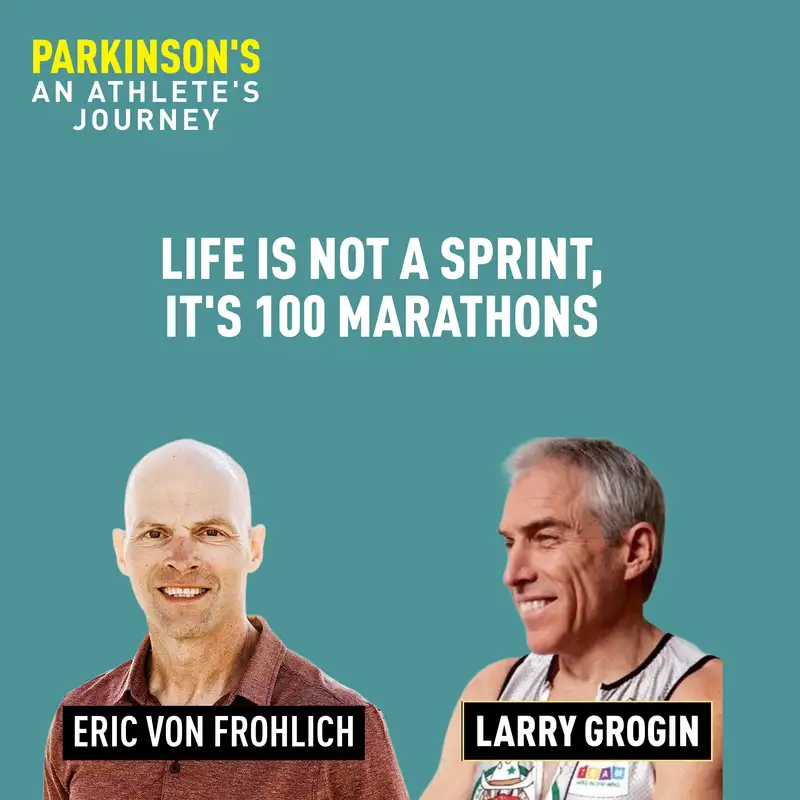
Life Is Not a Sprint, It’s 100 Marathons | Larry Grogin
Eric (00:31)
so we're back with Larry Grogan after his amazing event of a hundred marathons in a hundred consecutive days. How you feeling, Larry?
Larry (00:41)
I am feeling stronger than I was in March. So that's a good thing. Stronger and optimistic and I'd had a a healthy dose of America.
Eric (00:50)
what what is what did you learn from that first hundred days and the hundred marathons now that you've accomplished it? What what's the takeaway that you've learned about Parkinson's that you didn't realize previously?
Larry (01:02)
Well it it applies beyond Parkinson's, as you know, is a l oftentimes the case that what applies for Parkinson's goes in the big picture too. And that is I had an as an assortment as would be expected of overuse injuries, an iliotibial band knee problem, a hip problem, a lot of muscle strains. And what I learned was that with the passage of time everything changes. And everything ultimately does and
becomes conditioned over time. And sometimes not focusing on it was a help where I would focus on kind of an automatic pilot and just not let the little aches and pains take over. But to say it in simple terms there, that no matter how scary something was, it didn't last. And we're still a tightrope, but I'd say that we're doing okay.
Eric (01:53)
That's amazing. So it's it was ⁓ just like a normal human experience, you happen to have Parkinson's as a byproduct of it.
Larry (02:03)
Yeah, that's true. I had with Discovery one day at about seventy-five eighty-five day at Marathons Inn. And that was I was having a particularly rough day. A really rough day. It was hot, it was humid, I was tired, I was sleep deprived, and I realized that these tough days connect the easy days. And that sounds like a silly statement, but it's not so silly. No matter how bad the days were, I said those bad days stand out.
Because in front of it and behind it it two easy days.
Eric (02:35)
It reminds me of what a friend of mine told me when I was operating my gyms. He said, Enjoy it while it works because there's lots of days when it doesn't work. And those are moments that you appreciate all the days that you took for granted that it was working.
Larry (02:48)
True, true. And you you you've to be c in my life a perpetual chronic optimist. So you like a thought I had another another thought that stood out, and that was, as you know, the time you make a firm diagnosis, they say sixty percent or so of the nerve cells that produce the dopamine are dead. Dead cells, no good, not working anymore.
And we know that exercise is neurotrophic, may create growth in the nerves, unlike any other remedy. So that's one thing. But I had another thought. And that was if 60% of the nerves are dead, finished, kaput, not functioning anymore, that means that there's 40% of perfect nerves in there. And that's a lot. I thought about it when I was running and running better and stronger for having run the hundred days. And I thought,
Those forty percent of functional nerves are doing their job. And as you well know, our bodies have backup systems galore. So I have no doubt that that forty percent of good, perfectly operating, dopamine producing nerves did their job almost like I was a normal person.
Eric (03:58)
Which is remarkable. It's it's true that if you you lose a limb you build the adaptability or if you lose a sense, you build more adaptability in your other senses. So your body compensates remarkably well. And it shouldn't be any different for Parkinson's, I would imagine, as as it is with anything else. If take it away and you you require more from what's left, body adapts to that change and
And the Parkinson's is is the progressive side, but that seems to be offset with all the exercise that you do. So a remarkable achievement.
Larry (04:37)
know you're a great lover of quotes, and my dear departed dad had a quote that he used to say that I think applies here beautifully. You gotta have a backup. You gotta have a backup.
Eric (04:49)
that reminds me of the the the quote of you know, the only reason to have a plan is so that you can have a second plan that when the first plan doesn't work.
Larry (04:58)
⁓ I'll plan on that.
Eric (05:02)
Exactly. So a hundred days in and you're a hundred days older and a hundred days wiser, you got twenty six hundred extra miles in your body and you're feeling pretty good, although you're ready for a break. What's the first thing you're gonna when you get done with your last marathon?
Larry (05:21)
Hmm, I haven't thought about that. I know I'm not gonna have a waffle. I've had too many of them in these hotel free breakfasts. I think I think I'm gonna e jokingly may have said it on your your report that if I go to purgatory, they're gonna serve waffles.
Eric (05:38)
Yeah, that would summarize purgatory for me pretty well. I'm more of an eggs guy.
Larry (05:43)
So I don't in answer to your question, I'm gonna give thought and I promise you I will have an answer for you the next time we speak. I will have an answer of what I did eat, but I I can't think of what I would I mean, I've been eating pretty good. I have sumptuous dinner almost every single night, almost without exception.
Yeah. I know Pete Kostelnik, when he finished his race, he was so looking forward to a gallon of ice cream. he ate the gallon of ice cream in about a minute fast. Pete, you might note, if just want to really make my accomplishments seem minuscule, ran from San Francisco borough hall to New York City borough hall, over three thousand miles, he did it in a averaging seventy nine miles a day in forty four days.
Eric (06:29)
Amazing. There was a gentleman in my gym that used to train him Middleman.
Larry (06:34)
I know, Stu. Great guy.
Eric (06:36)
He would put a backpack on and get on a treadmill and equinox at eight in the morning and he'd go until six at night and ⁓ probably not even doing it justice. That was just before he had a meal. he was quite a remarkable person, right?
Larry (06:50)
Indeed, indeed. No limits, right? No limits. Yeah. Yeah, I just thought of something. I I I think about how lucky we were to be able to do this and one of the thoughts I have is a thank you to Honda of Mawa. They gave us a car and they said if you need an extra two or three, just tell us and we'll give them to you and that Honda cars has performed so well for us. I am so grateful to him. I don't know that I would have been able to do it without him.
Eric (07:14)
great that you got the support that you needed along the way. I remember that you ⁓ absolutely named the car Herbie after your d after your dad, right?
Larry (07:26)
Thank you for remembering that. That means the world to me, Eric. When I saw that in print summarizing our conversation a couple of weeks ago, it touched my heart deeply know that my papa was there with us for the ride. So thank you for that.
Eric (07:38)
The apple doesn't fall far from the tree, right?
Larry (07:42)
Well, Dad, i we i if we're thinking about Herbie the the person, not the car, he had a quote, he said, The apple doesn't fall far from the tree unless it's on a steep slope.
Eric (07:52)
Right. And then it rolls down the hill, lands in a river and just goes on its own journey.
Larry (07:57)
Right on.
Eric (07:58)
Either
a product of our parents or we're finishing unfinished business of our parents.
Larry (08:04)
Hey, if you ever decide to go in the backwoods of Africa, that Odyssey, which seemed like a mom's soccer mom's car, when in the what where was it that we were on some it looked it resembled Grand Canyon? was treacherous roads and I had run ahead and the support vehicle had two support drivers in it and they were worried about me, so they decided to drive down this road.
And I know I had already been on the road and knew that if the car went over that it would have been trapped there for eternity. So I came up there screaming saying, Turn around, turn around, go back, go back. But the sh the short of it was the Odyssey performed pretty damn well under some pretty adverse conditions.
Eric (08:44)
I ⁓ owned a Honda Odyssey for a couple of years. I don't currently have one, when I had the young children I had one and it was magnificent. So nothing but great reviews for Honda Odyssey. So congratulations on picking a good sponsor and someone who would support your mission.
Larry (09:02)
what's that statement? No good deed goes ⁓ unpunished. No, I this was happily right thing, that a good deed went rewarded. Out of the kindness of their heart, they did that and gave us the car when we needed a support of a trunk on the top and they right away ordered it. were so cooperative. And when People magazine did a quick story on us, I I was wearing the Honda vest.
Eric (09:06)
Yes.
Larry (09:27)
So I thought, isn't this nice? He didn't never knew he would get this, but he got some really nice publicity. I was so happy to share that for
Eric (09:34)
We're only as strong as our support team. So to segue, how was your support team built around this mission and did they take out of it?
Larry (09:44)
Well, with three days left I don't wanna jinx it because I'm allowed to be left on the side of the road.
wait a second. You know, the the motto has been run, Larry, run. I'm going to get in the car. And they said, No, run, Larry, run. The answer is I have done it without help from so many people in so many ways. And I'm so grateful for that and so fortunate to have been able to have this adventure and be able to meet thousands of people and see how other people live all around the country. It was an opportunity of a lifetime.
And today I was running in Lake Kastaic LA County Park, which was where I did my very first triathlon.
Eric (10:31)
I believe that's the home of the Olympic rowing trials as well in nineteen eighty four.
Larry (10:35)
You're exactly right.
You are a smart man and they were practicing from Cal State Northridge. Today I watched him on the water. But what a fun thing. It was forty-six years ago that I did my first triathlon as a relay. I was the bicyclist, did the nineteen mile bike. And it's kind of a funny story. Stan Curland, who's deceased and missed and loved by so many, was the swimmer. He swam at Cal State Northridge. He did the swim, I believe was a one mile swim or one kilometer swim.
Followed by my bicycling nineteen miles on a bicycle that was for a four foot eleven wife, but I made it work. I bought a helmet the night before and replaced the two bald tires. And then the on our team was my younger brother who was the runner who did the ten K run and he was so proud to say nobody passed him on the run, and I said, I hate to tell you nobody was left on the course. But I think I went back
I went back to visit it today, Eric. So it was so nice forty six years later to come full circle after a lifetime of doing these triathlons to be able to come back and visit the same place once again, same water.
Eric (11:48)
Yeah, it's very full circle.
Larry (11:50)
Yes, indeed. we start, we finish and if we're really lucky we get back to where we started from a little quicker. I'm not sure what it's a
Eric (11:59)
That that's the beauty of of running a race is you know, you're always looking forward to the next one.
Larry (12:05)
Yeah. Well I don't know about me. We'll see about that. I I think I might race by myself, so I'm short of a gold medal.
Eric (12:14)
Yeah, it's amazing what you've did you have any hiccups your medications? Or did was that pretty much the way you expected it to go? Because I remember from our last conversation you saying you don't really rely on your medication that much. It's one or two times a day.
Larry (12:32)
I will share with you I've been taking them more consistently three times a day, the light dose, the little yellow happy pills, little carbo levadopa. And what I've noticed is if I don't take all rounds, three doses, that my tremors are a little increased. So it'll be interesting to see when my activity level drops. Obviously it's gonna drop down these next couple of days drastically. I've been doing six plus hours a day of running, so
And I'll be interested to see what my dosages are like. I'll report back to you.
Eric (13:05)
Now I remember you were you were talking about the need to warm up slowly and to give your your body a chance to acclimate to your activity level. So you spend a great deal of time warming up slowly. Has that changed and has the body become more efficient or is that still the you know the way you do it?
Larry (13:26)
I'm glad you asked that question. The warm-ups are still a regular part of, and I'm more re respectful of them even than I was a few months ago. So I respect them and I don't stop moving, but I slow down the movements. And the great news, the absolute great news that I think is gonna really change the way people think about exercise, is that on a daily basis, and I welcome the public to look at my daily posts.
'Cause we as I think you've gotten to see at mile twenty six we've been videotaping my last couple of minutes of running and it is getting consistently better and stronger for the usage. So in other it's gotten better, more after a long, slow warm up, and what we're seeing is faster and faster, cleaner, smoother, more balanced, more smooth and easy running. And to put it simply, I look more like a runner now than I did four months ago.
Eric (14:22)
That's your
Larry (14:23)
It was that's great news. And I hope that people will hear that and say, Hey, Larry is not unique. Larry is what I am, and I'm gonna do it too. And I hope that people that are listening to this broadcast, I know you have a highly athletic population, and I assume that there's people that are less athletic, and I hope they get the message that movement is medicine. Because it really is. It really made a difference. And I when it first happened, I was in disbelief and thinking this is gonna go away.
But it's gotten better and better right through to today. It's better at the end than it is at the beginning.
Eric (14:57)
So maybe the moral of the story, Larry, is that you don't run enough.
Larry (15:01)
Well, we said it, right? If we said i if people around you don't think you're doing too much, you're probably not doing enough. ⁓
Eric (15:07)
Yeah, that that's a great quote. It's one I I referenced quite a bit since our interview. true. If people don't think you're a little crazy, then probably the crazy ones.
Larry (15:18)
Right on. And what's wrong what's so crazy about what's so bad about being crazy, right, brother?
Eric (15:24)
Well it's true. It's it's the crazy people that probably figured it out a lot sooner than the people who were just following along.
Larry (15:32)
when I was in Durango, I met the the group, the the Parkinson's Warriors, which is the nicest group of Parkinson's patients I've ever met in my life. They are such a tight-knit group of people. You interviewed Pat Morrissey, Patrick Morrissey on the great rowing team. And I am such a big fan of him and Bell, and
Katie Kojik, who owns a boxing gym and runs a support group in Durango. That is such a great group of people and we got to talking with some of these other crazies and I use the term and talking as you and I talked about about a boot camp for Parkinson's patients, 'cause it seems to me that the real solution is to exercise vigorously for hours and hours and make that the lifestyle.
Eric (16:19)
Right, particularly if you're if you're on the older side and you've retired, it's a nice way to fill your day and it's a nice way to structure your day with some purposeful, meaningful activity.
Larry (16:31)
Absolutely. And and as you well know, for every reason in the book, there isn't a symptom of Parkinson's that isn't affected in some positive way exercise. Th from the emotional to the physical to the metaphysical to the spiritual. It's all all helpful.
Eric (16:48)
Right. Never mind the neurological and the all the brain plasticity that seems to happen as a result of it. the discovery is what we're actually gaining as a result of having is as much as what we've lost. talked about that in the past a couple of times, about the law of compensation and that you can't lose something without getting something of equal value in return.
Larry (17:10)
You know what's another thought, and and I don't know if you're familiar with Cybervision, the inner game of tennis, inner game of golf, inner game of it was popular in the eighties and it was to enhance sports performance from skiing to golf to tennis to I think every sport in the rainbow. And I was thinking about that a lot. Obviously I had a lot of time these last couple of months to think about it. And I was thinking about we activate our automatic nervous system. the
principles of that inner game was to go on automatic pilot and not overthink and not interfere with your deliberate efforts. And so I think there might be a revitalization of the inner game sciences for us as Parkinson's patients, 'cause I found myself sometimes when I was running smoothly and cleanly, really relaxing and not trying to run, instead just
Eric (18:01)
Right, which is a pretty good metaphor for how do you should be living your life with Parkinson's. You should be living your life and making the most of that and most of the opportunities that you want to, as opposed to worried about your Parkinson's and how that's affecting the rest of your life.
Larry (18:17)
Exactly. I felt such a warm bond with the the Durango Parkinson's I w I wish there were more groups like that. Coming from the New York City metropolitan area, there's a couple of small, weaker groups, but nothing nothing that rivals the Parkinson Warriors. That is such a tight knit group and it made me appreciate how much having a community to work with would be helpful for all of us.
Eric (18:42)
Yeah. Can you speak to that a little bit? Like having a support team the way you had it your challenge of a hundred marathons in a hundred days is one thing. The support team that you need to live your daily is another. How do you build your support team for your daily life?
Larry (18:58)
Well, I I'm a work in progress. I think you know, putting together the and organizing well in advance of this group required me to have a lot of caretakers. A lot of caretakers far reaching and I and when I allowed them to help it made all the difference in the world. I think that's a work in progress and something that maybe we should pay more attention to to figure out how as a community we provide it.
other athletes and through people that not just other Parkinson's patients, but being willing to let other people help.
Eric (19:31)
Yeah, I think that that's a that was a takeaway from my Alaska trip, is that I was able to do the thing that I came to do, which was spend time with my family and my children fish and and have great memories, because I was willing to let the captain of the boat do his job and and take care of us and was willing to take the help from my family to get my lunch prepared and I could focus on the things that were challenging, like my balance and my coordination.
because I wasn't worried about a lot of the other things that were maybe more technical or more that skills that I not as as proficient as I normally am. speaking apparently is a problem right now.
Larry (20:12)
may I interrupt you?
Eric (20:13)
Yeah, of course, please.
Larry (20:15)
You just mentioned the speech and I was thinking I was sitting ha how long ago was it, maybe two months ago that we did our first podcast together? two months ago your speech was not the same as it is today. For what it's worth, I was thinking just a few moments before we got to that topic just now that your voice seemed clearer and more comfortable and and more smooth and graceful.
Eric (20:24)
Yes.
Larry (20:40)
Right now it seems highly improved.
Eric (20:43)
Well, that's that's good. went through some physical challenges. I had an ablasion for an arrhythmia that I had. And that led to some complications. So I've had some downtime and I think the downtime to recover has been helpful. But I've also, you know, had trip which was magnificent and wonderful and it was long and exhausting, but
It was and empowering because I realized I can do a lot more than I give myself credit for sometimes. So I'm happy to hear that my voice sounds a little stronger and more robust and and more vibrant because that is one of the things that I'm a little self-conscious of and try not to ⁓ not try to overanalyze even when I have some difficulties. I just try to accept it and then move forward as best I can.
So thank you for that, for acknowledging that and it's meaningful to hear.
Larry (21:41)
You bet. Li life is just a bowl of dopamine, right?
Eric (21:45)
Exactly. Well, let me think I I I do have some questions. Did you visualize gratitude breathing or other mental techniques as you were going through difficult miles?
Larry (21:56)
Okay, so I I considered it that I had this bag of tricks and having done the marathons day after day for the hundred days, ninety seven so I had practice at saying do I take out of my magic bag of tricks? And one of the go to's music. Another go to was music and dancing. Another go to was I had a couple of people I'd call on the telephone, whether it was my sons, one of my ex wives.
And just keyed into it knowing that I was connecting to feel better. Sometimes I would focus on nature. Birds were a big we we touched upon that briefly a couple of weeks ago. It seemed like the birds really made themselves, their presence known when I really needed them. And that was true for nature. Nature in general, but birds in particular. I saw more beautiful birds and listen to how beautifully they chirp.
You know, we talk about music as being a dopamine producer, but a bird chirping is pretty pretty remarkable music. And even though I look like Bozo the Clown dancing, I thought Fred Astaire had nothing on me.
Eric (23:07)
Well, you're a a legend in your own mind, Larry. That's it's the birds I can attest to because the eagles were swooping into the bait balls that we were fishing around and they would be chirping and and scooping up hands full or talons full of fish, and it was really quite spectacular. And then when it couldn't get any better, a well would breach and saw half the fish in one mouthful.
Larry (23:11)
Yeah.
Eric (23:33)
And this would all happen maybe twenty or thirty feet from the boat. it was remarkable to be immersed in nature to that extent and to really feel vibrant because there was no cell phones, there was no technology, there was just the sound of your voice and the beating of your heart to keep time and rhythm of the day. And it was ⁓ agree with you, the the power of nature and out in that is ⁓ is incredibly rewarding.
Larry (23:58)
we touched upon being nutty and I know that I sometimes will say as a term of endearment, I'll tell somebody that I like, they're crazy, they're nuts, they're odd. And I don't realize that I'm offending them because that's certainly not my intention. But when we go back to what I did in some of those more desperate moments when I was feeling like, Am I gonna be able to take another step? My my legs feel like they're in concrete now. What am I gonna do?
And a little nutty was probably my best saving grace. And it could have been the dancing or the music or s making silly noises. Sometimes I was watching the birds and trying to glide like the birds, or remembering how dolphins glide. So I think in simple terms, one of the tools that I pulled out of my handy bag was be nutty, be crazy. Crazy is underrated.
Eric (24:49)
The potential to embarrass yourself seems to be underappreciated.
Larry (24:54)
Well, there were times where I was on busy roads and cars were definitely wondering what the heck was going on. I had three different occasions where a police officer said somebody said they needed us to do a wellness check. And the policeman stopped and they said, What are you doing? And I told them they said, That's so great. That's wonderful. I did a ten K and in all three instances the policeman ended up befriending me and saying, Have a great run. But I but I appeared to be pretty nutty and so what?
Jimmy Crack Corn.
Eric (25:25)
Right? Exactly. Well, would never change and never get better if it wasn't for some deviation from the norm. So that's you know, more power to you for figuring out how to get through it. what was the power of music that you're telling telling me about? Because I've heard that quite a bit with Parkinson's, that the rhythmic drum beat or the rhythm of music seems to be very beneficial.
Larry (25:48)
Well, my f good friend Deborah Henson Conan is she's been described as Jimi Hendrix with a harp. Some of you listeners might know him. She she wrote a she wrote a song, I think it's the most recorded song on the harp called Nightingale. And I became friends with her when I was studying the harp. I'm not a harpist, but I study it and wish I was, and Deborah is a master and she actually sent me recorded
music, original music that I can run to that's at a hundred forty and a hundred fifty per minute and it has been tremendous in kind of just working a little faster than your heart beats. So sometimes I'll pull out some of her harp music and it's just fantastic. Just magical. I sing. John Mayer Sirius Satellite Radio has been a a guiding friend.
Frank Sinatra has been a a pal, Tony Bennett, Shirley Vasse. I've got a lot of people running with.
Eric (26:44)
You certainly tapped into some some legends. So power of music is something that I need to back into my workout. I don't think I've taken full advantage of that. So it's encouraging to know that that's beneficial.
Larry (26:57)
Along that note, I challenge you in the next week I promise I will send you a favorite three songs if you'll send me three of yours.
Eric (27:06)
Sounds good. Okay, something to look forward to. So what would you tell that person who's newly diagnosed, who's afraid that they never can be as as athletic as they used to be, or that they're gonna lose all this fitness and health that they that they've built up over their life? What what do you tell that new person who's diagnosed the power of exercise and the power of movement?
Larry (27:29)
Okay, I will answer you, but first I want to say a thank you for asking that question because I'm I think it is I'm so fortunate to be able to have the microphone to answer your question right now. And I hope that somebody that was just diagnosed in at this moment to hear me say these words. You're not dead. You're not dead. If you're dead, you'll know about it. And you know there's another quote which I'll interject and finish my point.
Shortly after I was diagnosed, I think I said this to you. I said I nobody failed at nobody has ever failed at dying, so I'm gonna just wing it and concentrate on living. And you're not dead. Parkinson's is a diagnosis. It gets in the way a lot in every which way you you could make a list as long as the Nile River is long for everything that's horrible and depressing and repressing and weakening and scary and frightening and power-
grabbing and everything bad, or you can say I'm still alive and Parkinson's is not going to kill you. You're gonna die but you're not gonna die from Parkinson's.
Eric (28:37)
I completely I completely appreciate that. And you were gonna say a little bit more about running about exercise.
Larry (28:45)
Well, the the exercise is exercise is a panacea. I used to say it's almost like exercise is a panacea, and then I said, What am I apologizing for? Movement is life. Movement is the difference between live and dead. And when you have Parkinson's, you can become stronger, more powerful, quicker, everything if you want to. If you live long enough, you can do anything.
Eric (29:08)
There's a strength coach from the East Coast named Charles Polloquin, who recently passed away, but he was a legend in the strength and conditioning world. And he was famous for saying that if ⁓ exercise could be put into a pill it'd be the most powerful expensive drug in the world.
Larry (29:25)
Amen. And if if doctors could figure out how to charge for it, we'd be told to do it a lot more frequently. If pharmaceutical companies w able to make money for people running out of breath, they would do it.
You know, somebody said early on in my Genesis, they said Larry's running for people that think they cannot. And there's a lot of power in that state. There's a lot of power in that statement because what it says is they think they cannot, but they can. And there's nothing special about what I accomplished. What I accomplished was my best effort to run across the country.
And that best effort was what anybody could do. And that was the point we wanted to make. We didn't want to make a point that Larry's an exceptional athlete or Larry's strong willed or Larry's inspirational. What we wanted to sell to the world was if Larry can do it, I can do it. And that's the message I hope comes through loud and clear. And that everybody lives their best life believing that anything is possible and without Parkinson's.
Eric (30:22)
That you've done an amazing job at describing because I agree. everyone that we we've showcased wasn't about their own journey and about what they've accomplished. It was about the inspiration that they provided to prove to people that if they could do it, then anyone can do it. And that's the the group out of were a remarkable example of four men who happened to be great athletes, but came together with a common purpose and
accomplished something that was truly remarkable and inspired hundreds of people along the way, if not thousands of people along the way, to reach a little deeper and try a little harder and maybe think a little bigger and start living their life to its fullest. So it's it's a beautiful sentiment and I appreciate you reiterating it and making so alive for us.
Larry (31:12)
Well, let me say another thank you because because of the work you're doing, Eric, with this podcast, you're getting the word out for people that that question you asked me can be played back now for that person that just gets diagnosed. And thank goodness you're doing the service that you are to make that broadcast. You're providing an avenue for people to hear that. I know when I was diagnosed seven or eight years ago, I would have given my kidney or my liver out to hear something that was hopeful.
Not something that was doom and gloom. And that's what you're doing with this podcast. So God bless you.
Eric (31:44)
I appreciate the support and I'm looking forward to giving you a big hug in a couple of days. So it's we gotta make sure that that happens on Wednesday.
Larry (31:53)
have to do another seventy eight miles first, I think, right? Three times twenty five? Two times twenty five.
Eric (31:58)
⁓
Twenty twenty-six point two to be technical. But you've met thousands of people on this journey, right? And any in in interactions in particular stand out? I think you mentioned the group in Durango, tell me about the ⁓
Larry (32:08)
Yes.
Eric (32:17)
an example of someone that you met that really impressed you or was inspired by you on your journey.
Larry (32:23)
What was so impressive was everybody looked up and smiled. Everybody. I saw the most beautiful smiles. I could have done a dental commercial from one state to the next. And it is thousands as I'm starting to r I hadn't allowed myself to think about it. And I'm starting to break down and start to remember so many of the memories because I was trying to stay focused in the moment. Eric, I saw so many beautiful smiles. People, when I said,
Can I give you an orange wristband and will you agree to wear it until July first? And with one exception, one doubting, it was close to somebody near Columbus, Ohio, that was walking with his two little girls on the bike on their toy bicycles, and he was skeptical, thought I was some maybe giving out Bibles for Jesuit priests. But what what is overpowering and just like I said, just with one teeny tiny exception
tens of thousands of people that smiled and said, Thank you for what you're doing. And they were thanking me for giving other people hope. And it was such a beautiful side. was America and it was people caring.
felt like I had a front row seat at a love fest. And that love fest was the United States.
Eric (33:38)
It's amazing that people came out to support you as much as they did in something that's unfathomable what you were truly remarkable and I I marvel at your humility also because Well I
Larry (33:52)
Yeah, let me interrupt you and say thank you for that, but I just took a run. I just took a run.
Eric (34:00)
You took a long run, Larry.
Larry (34:02)
I took a very long run, but it was just running.
Eric (34:05)
the the takeaway and the inspiration that you've that you've provided for thousands and you know is is really the magic of what you've done. And I can't thank you enough for doing
Larry (34:17)
Well, I I hope I hope it lasts because I won't do it again.
Eric (34:21)
Well it's ⁓ I think you've inspired people as as some of my other guests have, to realize that their dreams are are maybe not as big as they need to be. We think we have to inspire people not just live with Parkinson's but to thrive with Parkinson's.
Larry (34:38)
well said, and I hope your podcast runs for the next hundred years.
Eric (34:43)
Well hopefully we in the next couple of years we solve this problem and people will have something else to focus on. And then they'll realize that they have the same problems with aging and the answer is exercise as well. And you know, eventually we the answer goes back is medicine and frequency is magic and community is the support that you that you can harness around yourself to.
out and show up and a commitment to doing something that's good for you not only you but for the people that are inspired by you as well.
Larry (35:17)
Well said. And can I tell you what I've my two sons have agreed that I'm gonna put this on my headstone. It's from a Stephen Wright joke.
Eric (35:26)
Okay. It's better to good though for the headstone.
Larry (35:30)
I'm planning to live forever. So far it's going great.
Eric (35:36)
Stephen Wright was underappreciated for his genius. Your boys, how how have they been in in you taking on this journey? Is this dad just being dad or is this they've come to appreciate commitment to making Parkinson's community
aware inspired.
Larry (35:55)
Well, thank you for giving me an opportunity to plug. My inspiration for doing all this was to hopefully build a pavement for them to to live their life on and know anything is possible. been the greatest and most supportive and wonderful despite missing me and me not being available in normal dosages. They've been loving and supportive and I couldn't thank them enough.
Eric (36:21)
children are a remarkable way to develop as a human being. I'm sure there's other ways you can master music and you can master many things in life, but to raise another human being to adulthood is a remarkable challenge and I give a tremendous amount of appreciation and and gratitude for those who take
Parenting as a and make the most of it because there's nothing more challenging in life raising another human being and lifting them up and helping them be everything that they can be and then watching them walk out the door and if you've done your job, they don't need you anymore. They certainly appreciate you, but they they don't need you as as much as when they started out. And that's a remarkable gift.
Larry (37:08)
That's beautifully said, Eric. I I'll put one tag on that. There's a quote that I love that's your worst fears are not gonna be okay and your second worst fears, they are.
Eric (37:19)
Right. let me let me l shift gears a little
if you could sit down with the version of yourself who has been diagnosed in two thousand nineteen, what would you tell now that you've run a hundred marathons in a hundred days.
Larry (37:35)
The life is not a sprint, it's a hundred marathons.
Eric (37:40)
⁓ Well said. And so there's opportunities to to thrive and there's opportunities to fall and there's opportunities to trip and back on your feet again and continue on. And you've been an amazing example of that. I'm sure you've had high moments and low moments. Anything that stands out that you want to share with us?
Larry (38:00)
Well, there was a a a downtime. I got to know my downtimes much better about one o'clock. Of course, with the time change it changed, but starting out at one in the afternoon, I had a downtime. And about nine o'clock in the morning I had a downtime. And what I learned, getting that lesson day after day, you know, it really gets pounded home when you're doing something seven days a week, week after week after week after week after week. And what I learned was that those downtimes end.
And we as Parkinson's patients have a unique thing that we get to be reminded of it every day, that when it gets bad, it's not gonna stay bad, that it will end. And it did. Out of ninety-seven days so far, every downtime came to an end and was followed by an uptime. So I learned that lesson no matter how bad it is, it's not gonna last forever. And I didn't know that seven years ago, like I do today.
Eric (38:57)
and you you took a journey to figure that out. So that's a remarkable thing because I don't I won't have to run a hundred marathons in a hundred days. I can just trust you.
Larry (39:06)
You don't have to invent the wheel, right?
Eric (39:09)
Yes.
Larry (39:10)
Yeah.
Eric (39:11)
smart people learn from their experience, wise people learn from other people's experience. And so I'm gonna trust you on the what you've covered what you've taken away from this lesson and is in fact what you were meant to take away from it and share with the rest of the world. So thank you for that. And I got one more question for you. What does an athlete's mindset mean to you today and how has Parkinson's made you a better athlete?
Rather than just a different athlete.
Larry (39:39)
can I can answer that pretty clearly. I took a quick look on my cell phone at a map of the United States and I just glanced at how far we came. And if you would have said to me back in New Jersey, back in March, it was freezing cold March twenty fourth. And if you would have said to me you're gonna run all the way across the whole United States, all the way across from
state to state, meeting one person after the next, one traffic light after the next, one highway after the next, one hotel after the next, one waffle bread after next. What I've learned after ⁓ ninety seven days on the road, besides what I've learned is that I don't want to stay at another hotel for the next five hundred fifty years.
Eric (40:19)
You need a better hotel sponsor.
Larry (40:22)
But but what I really did come away from it that I think has shaped me as an athlete for whatever that's worth is that I could look at a map of the United States and say, I could cover that map. And I would have said that a year ago and not known that it was really true. Now I know it's true. Before it was a belief of mine, now it's a fact. changing beliefs, strong, powerful beliefs into facts.
is I think making me a more substantial person. And I do really believe that anything is possible. I think if somebody wants something enough and is willing to live and work at it with all that they have, that anything is possible. And I think I believe that more now than I did a hundred days ago.
Eric (41:07)
Well, it's a powerful message. It's ⁓ know, and I agree with you. I think there's been examples throughout time of, you know, men wanted to fly like a bird and ended up having to invent an airplane to do it and eventually a wingsuit to do it. know, time and time again heard the message you believe you can achieve, yeah
To see someone go out and do it and do it in real time and be able to follow them join them for their ups and downs and and to hear about their stories afterwards. Is there gonna be a book coming, Larry?
Larry (41:41)
We'll see. But I was thinking while you were speaking here, and there's that quote that came up that it's not my quote about Larry is running for people that think they cannot. And maybe as a reward for my diligent efforts, for my hard fought efforts, that maybe anybody that reads that quote, I'll say it one slowly, Larry is running for people that think they cannot, to add a little tagline onto that to say, maybe try. Right.
So maybe the new statement that's come out of this that wasn't there back in March is Larry is running for people that think they cannot, but they'll try. And that would be so worth the effort, right?
Eric (42:24)
amazing you've you've given a call to action that is inspiring and more importantly, it's achievable. And so I appreciate all that you've shared with us and all that you've done. and you've done it for your for your lifetime. So you've been a very consistent human being in what you've accomplished.
It's inspiring and it's and it comes from such a beautiful place that you're you're doing it to inspire others instead of to salute yourself is something that I think we can all take away from and ⁓ I want to share some appreciation for the people that supported you in this your sponsors and your support group and your caretakers.
Because we're only as strong as those we surround ourselves with and we only feel the love of the people we invite into our lives. So, to you for building an amazing team around yourself as well as what you've accomplished
Larry (43:20)
Thank you, Eric. Thank you very much.
Eric (43:23)
It's remarkable and I appreciate you as a human being and I look forward to seeing you at the finish line give you a big hug maybe eat a gallon of ice cream with you.
Larry (43:34)
And that's a deal. Then don't start without me.
Eric (43:38)
I I promise.